Fun Facts About Dolphins: 20 Things You Did Not Know About the Animals at Blue Lagoon Island

Posted: July 13, 2026

Black and white icon of a calendar.
July 13, 2026

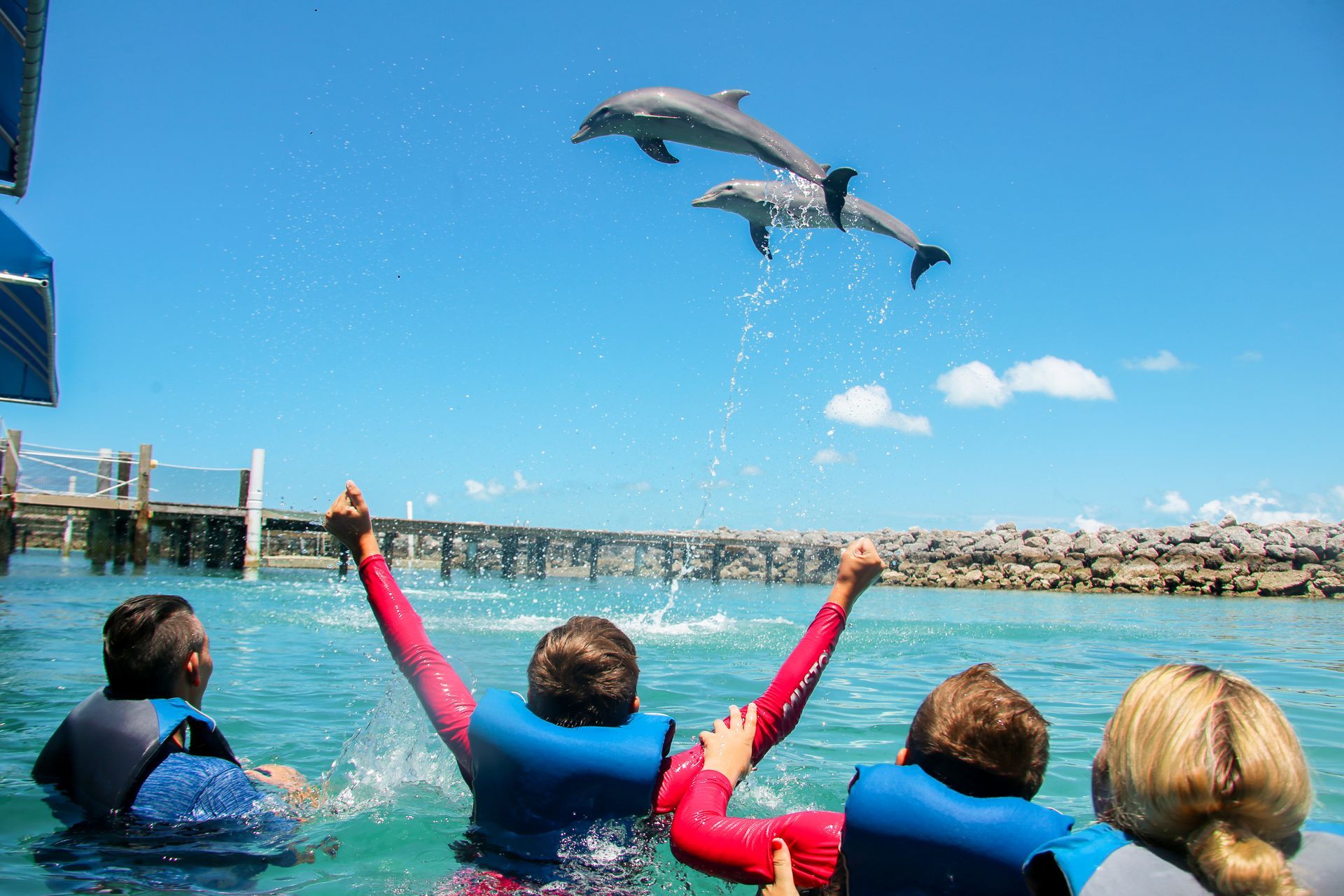
The most fun facts about dolphins are the ones that change how you see them. Dolphins are warm-blooded mammals, not fish. They call each other by name using signature whistles, they sleep with one half of the brain at a time, and they "see" with sound through echolocation. The dolphins you meet at Blue Lagoon Island near Nassau are Atlantic bottlenose dolphins, one of the most studied and most intelligent animals in the ocean. This guide rounds up 20 of the most surprising, well-documented facts about them, from how long they live to how fast they swim, so your next encounter, or your memory of the last one, feels even richer.

Most of these facts are true of bottlenose dolphins everywhere. A few notes are specific to the dolphins at Blue Lagoon Island, where many were born and are cared for under recognized welfare standards. Where a fact is about dolphins in general, we say so.

What Kind of Animal Are You Actually Meeting?

Before the surprising stuff, the foundation: a bottlenose dolphin is a mammal, not a fish, and almost everything interesting about it follows from that.

1. They Are Mammals, Not Fish

Dolphins are warm-blooded, breathe air through lungs, give birth to live young, and nurse their calves with milk. They descend from land mammals that returned to the sea tens of millions of years ago. The clearest tell is the tail: a dolphin's tail, called the fluke, moves up and down, while a fish's tail moves side to side. That up-and-down motion is an inheritance from four-legged ancestors whose spines flexed vertically as they moved on land.

2. Their Closest Land Relative Is the Hippo

It sounds like a trivia-night trap, but it holds up. The closest living land relatives of dolphins and other whales are hippos, with a shared ancestor that lived roughly 50 million years ago. Dolphins are part of a group of animals, the cetaceans, that walked on land before adapting completely to life in the water.

3. They Are Bigger Than Photos Suggest

Adult Atlantic bottlenose dolphins commonly measure between about 6 and 12 feet long and can weigh several hundred pounds, with the largest offshore animals heavier still. The power and mass of a bottlenose dolphin up close is one of the things photographs do not prepare you for, which is part of why the in-water programs at Blue Lagoon Island leave such a strong impression.

4. They Stay Warm in Cool Water

Bottlenose dolphins hold a core body temperature close to our own. A thick layer of blubber under the skin insulates them, and a clever circulatory arrangement, where warm outgoing blood runs alongside cooler returning blood, limits heat loss through the fins and fluke. It is the same general principle that keeps many cold-water animals from losing body heat through their extremities.

Intelligence: The Part That Changes How You See Them

This is the cluster of facts that tends to stay with people. Dolphins are not just trainable; by several measures they are among the most cognitively sophisticated animals on the planet.

5. They Recognize Themselves in a Mirror

One common benchmark for self-awareness is the mirror test: does an animal recognize the reflection as itself rather than reacting to it as another individual? Bottlenose dolphins pass it, placing them in a small club that includes great apes and elephants. An animal that recognizes itself in a mirror has some concept of self, considered one of the hallmarks of higher cognition. When a dolphin holds eye contact with you in the water, that is the animal looking back.

6. They Call Each Other by Name

Every bottlenose dolphin develops a unique signature whistle that works like a name. Dolphins use these whistles to introduce themselves, to stay in contact, and to call out to specific individuals, and they can remember another dolphin's signature whistle for 20 years or more. Outside of humans, very few animals have shown anything close to this kind of individual naming.

7. They Can Recognize Individual Humans

Bottlenose dolphins can learn and remember individual people, including by voice, over long stretches of time. This is one reason the relationship between trainers and the animals in their care, including at accredited facilities like Blue Lagoon Island, builds over years rather than being a generic interaction with an interchangeable animal.

8. They Use Tools

In Shark Bay, Australia, some bottlenose dolphins tear off marine sponges and wear them over their snouts while foraging on the seafloor, a buffer against scrapes and stings. The behavior is learned and passed down through families, mostly from mothers to daughters, which makes it one of the clearest examples of culture, knowledge handed from one generation to the next, in any non-human animal.

9. They Solve Problems and Understand More Than You Would Expect

In research settings, bottlenose dolphins have shown flexible, creative problem-solving rather than rote responses. They have demonstrated an understanding that the order of signals can change meaning, a basic feature of language, and they can follow a human point to its target, a form of shared attention that is rare outside of humans and great apes. In the wild they coordinate group hunts and adjust their tactics on the fly.

Communication: The Language of the Lagoon

Dolphins live in a world of sound far richer than ours, and they are constantly broadcasting and listening.

10. They Make Three Main Kinds of Sound

Bottlenose dolphins produce clicks, whistles, and burst-pulse sounds. Clicks are used mainly for echolocation but also carry social information. Whistles, including those signature whistles, are the main channel for social communication. Burst-pulse sounds are rapid click trains that can sound like squawks or buzzes to us and tend to show up during excited or intense social moments. If you are near the water during a program, listen: the soundscape is part of the experience.

11. They Hear Far Beyond the Human Range

Human hearing tops out around 20,000 Hz. Bottlenose dolphins hear up to roughly 150,000 Hz, many times higher, which is the foundation of their echolocation and means they live in an acoustic world we can barely imagine. Well-run facilities pay close attention to managing the sound environment around their animals for exactly this reason.

12. They See With Sound (Echolocation)

A dolphin produces clicks and focuses them through a fatty organ in its forehead called the melon, then receives the returning echoes mainly through its lower jaw. From those echoes it builds a detailed, three-dimensional sense of its surroundings, judging size, shape, distance, and even the difference between materials. During an in-water program, a dolphin almost certainly echolocates you, building an acoustic picture of your body, a way of perceiving that has no real equivalent in human experience.

Social Life: More Complex Than You Might Expect

Dolphins are deeply social, and their relationships are not simple.

13. They Live in Fluid Social Networks

Bottlenose dolphins live in what biologists call fission-fusion societies. Instead of one fixed group, individuals form and re-form smaller groups within a larger community, with the makeup shifting through the day and the seasons. Keeping track of who is who across a large, changing network takes serious social intelligence, the same kind associated with high cognition in primates and people.

14. They Form Long-Term Bonds

Within that fluid structure, certain pairs and small groups stay closely associated for years. Male bottlenose dolphins in Shark Bay have been documented maintaining alliances with specific partners for decades, cooperating and showing consistent preferences for each other's company. Whether dolphins experience this the way we experience friendship is a question science cannot fully answer, but the long-term, voluntary, mutual nature of the bonds is well documented.

15. Mothers and Calves Stay Together for Years

Female bottlenose dolphins nurse their calves for several years, one of the longer nursing periods among marine mammals, and the mother-calf bond stays close well beyond weaning. Calves learn survival skills, social rules, and local know-how from their mothers during this long apprenticeship, and daughters in particular often keep close ties to their mothers for life.

16. They Help One Another

Dolphins have been seen supporting injured or sick companions, nudging them to the surface so they can breathe. There are also many documented accounts of dolphins coming between people or other animals and sharks. Helping others at a cost to yourself is rare in the animal world, and it is one of the behaviors that makes dolphins feel so familiar to us.

Physical Abilities: What That Body Can Do

The same body that looks so graceful in the water is also a high-performance machine.

17. They Can Sprint Faster Than 20 Miles Per Hour

In short bursts, bottlenose dolphins can swim faster than 20 miles per hour, quick enough to ride the bow wave of a boat or outrun most fish. Their streamlined shape is so efficient that engineers have studied it for lessons in reducing drag.

18. They Sleep With One Eye Open, Literally

Dolphins cannot fall fully unconscious the way we do, because they would stop surfacing to breathe. Instead they rest one half of the brain at a time while the other half stays awake to control breathing and watch the surroundings, often with the corresponding eye closed and the other eye open. A dolphin resting quietly near the surface is not asleep in any sense we would recognize.

19. They Have No Sense of Smell

Dolphins lost their sense of smell over their long evolution into ocean animals. They more than make up for it with extraordinary hearing and good eyesight both above and below the surface, plus the acoustic "vision" of echolocation. They also do not chew their food, swallowing fish whole, usually head first, and they have a multi-chambered stomach that handles the grinding their teeth do not.

20. A Group Is a Pod, and Sometimes a Superpod

A group of dolphins is called a pod. When food is plentiful or conditions are right, pods can gather into temporary superpods that can number in the hundreds or more. And one piece of trivia that surprises almost everyone: baby dolphins are born with a few tiny whiskers on the snout, a leftover from their mammal ancestry, that fall out soon after birth.

How These Facts Change Your Encounter at Blue Lagoon Island

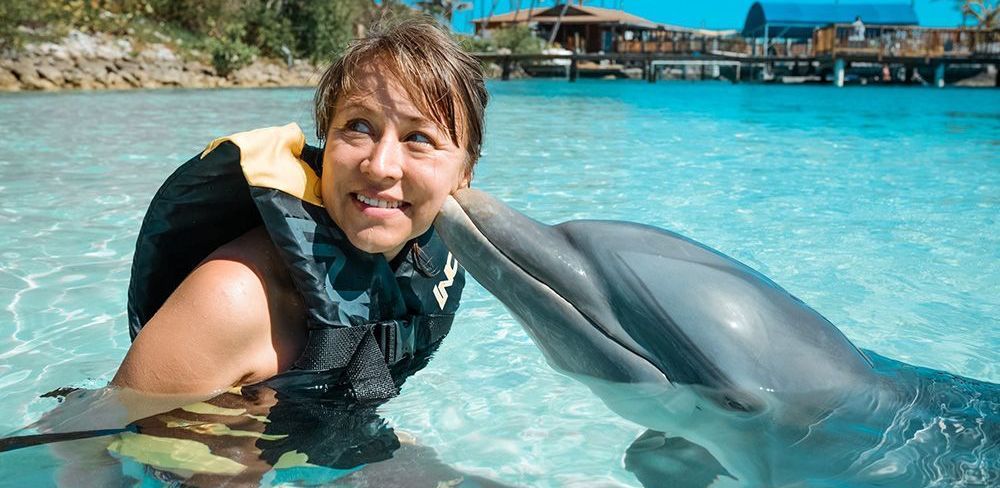
Knowing even a handful of these facts shifts the experience. The eye contact means more when you know you are being regarded by an animal that can recognize itself in a mirror, answer to its own whistle, and remember individuals for decades. The clicks you hear take on meaning when you know the animal is mapping you in three dimensions with sound.

At Blue Lagoon Island, the dolphins are Atlantic bottlenose dolphins living in all-natural, ocean-fed lagoons, and many were born right here. The facility is American Humane Certified and a member of the Alliance of Marine Mammal Parks and Aquariums, and its team trains using positive reinforcement and enrichment. Its nonprofit affiliate, Project B.E.A.C.H., focuses on marine education and conservation in the Bahamas. You can read more on the education and conservation page.

Want to meet them in person? Choose the way that fits your group: the waist-deep Dolphin Encounter for young children and first-timers, the deeper-water Dolphin Swim with its famous foot push, or the premium Royal Dolphin Swim. Every program includes the round-trip ferry from Nassau and lunch. Check availability at dolphinencounters.com or call 1-866-448-9535.

Frequently Asked Questions

How long do dolphins live?

Lifespan varies a lot by species. Smaller dolphins may live around 20 years, while larger members of the dolphin family can live much longer. Atlantic bottlenose dolphins commonly live into their 30s and 40s, and some individuals, especially females, live longer still. Animals in well-managed professional care are routinely among the older end of the range.

Are dolphins really that smart?

By the usual measures, yes. Bottlenose dolphins pass the mirror test for self-awareness, use signature whistles like names, use tools, solve novel problems, and live in complex social networks that demand strong social memory. Few non-human animals score highly across that many separate kinds of intelligence.

What sounds do dolphins make, and why?

Three main kinds. Clicks are used mostly for echolocation, the biological sonar dolphins use to sense their surroundings. Whistles, including each dolphin's signature whistle, carry social information. Burst-pulse sounds are fast bursts of clicks tied to excitement or intense social moments. Together they make for a constant, layered soundscape.

How fast can dolphins swim?

In short bursts, bottlenose dolphins can exceed 20 miles per hour. They cruise far slower most of the time and use that top-end speed for hunting, escaping, or surfing the pressure wave in front of a moving boat.

Do dolphins sleep?

Sort of. Because they have to surface to breathe, dolphins never fully lose consciousness. They rest one half of the brain at a time while the other half stays awake to manage breathing and stay alert, often with one eye open. It is called unihemispheric sleep.

  • How long do dolphins live?

    Lifespan varies a lot by species. Smaller dolphins may live around 20 years, while larger members of the dolphin family can live much longer. Atlantic bottlenose dolphins commonly live into their 30s and 40s, and some individuals, especially females, live longer still. Animals in well-managed professional care are routinely among the older end of the range.

  • Are dolphins really that smart?

    By the usual measures, yes. Bottlenose dolphins pass the mirror test for self-awareness, use signature whistles like names, use tools, solve novel problems, and live in complex social networks that demand strong social memory. Few non-human animals score highly across that many separate kinds of intelligence.

  • What sounds do dolphins make, and why?

    Three main kinds. Clicks are used mostly for echolocation, the biological sonar dolphins use to sense their surroundings. Whistles, including each dolphin's signature whistle, carry social information. Burst-pulse sounds are fast bursts of clicks tied to excitement or intense social moments. Together they make for a constant, layered soundscape.

  • How fast can dolphins swim?

    In short bursts, bottlenose dolphins can exceed 20 miles per hour. They cruise far slower most of the time and use that top-end speed for hunting, escaping, or surfing the pressure wave in front of a moving boat.

  • Do dolphins sleep?

    Sort of. Because they have to surface to breathe, dolphins never fully lose consciousness. They rest one half of the brain at a time while the other half stays awake to manage breathing and stay alert, often with one eye open. It is called unihemispheric sleep.

What kind of dolphins are at Blue Lagoon Island?

The dolphins at Blue Lagoon Island near Nassau are Atlantic bottlenose dolphins, living in all-natural, ocean-fed lagoons, and many of them were born on the island. The facility is American Humane Certified and a member of the Alliance of Marine Mammal Parks and Aquariums. You can meet them through the Dolphin Encounter, Dolphin Swim, or Royal Dolphin Swim.

Dolphins have a way of staying with people. The encounter is memorable not only because it is beautiful and fun, but because it puts you in close company with a truly remarkable mind: an ancient, intelligent, social, communicative animal that is, in its own way, as curious about you as you are about it. Learn a little about how they live, and every moment in the water with one means more.

If you are still deciding how to meet them, our companion guide on what to really expect when you swim with dolphins in the Bahamas walks through the programs, the foot push, costs, and ages.

Ready to meet the dolphins? Pick the program that fits your group and book directly at dolphinencounters.com, or call 1-866-448-9535. Every dolphin program includes the round-trip ferry from Nassau and lunch.

Read More Articles
California sea lion in shallow water at Blue Lagoon Island near Nassau
By Dolphin Encounters Team July 12, 2026
Swimming with sea lions at Blue Lagoon Island near Nassau: what the encounter is really like, who can do it, the cost, and a look behind the scenes.
Choosing between a dolphin and sea lion encounter at Blue Lagoon Island Nassau
By Dolphin Encounters Team July 11, 2026
Sea lion vs dolphin encounter at Blue Lagoon Island near Nassau: ages, water setting, what you do, and prices compared, so you can choose with confidence.
Swimming with dolphins in the Bahamas at Blue Lagoon Island near Nassau
By Dolphin Encounters Team July 11, 2026
Swimming with dolphins in the Bahamas? What to expect at Blue Lagoon Island near Nassau: the programs, the foot push, costs, ages, and how to choose.